Context
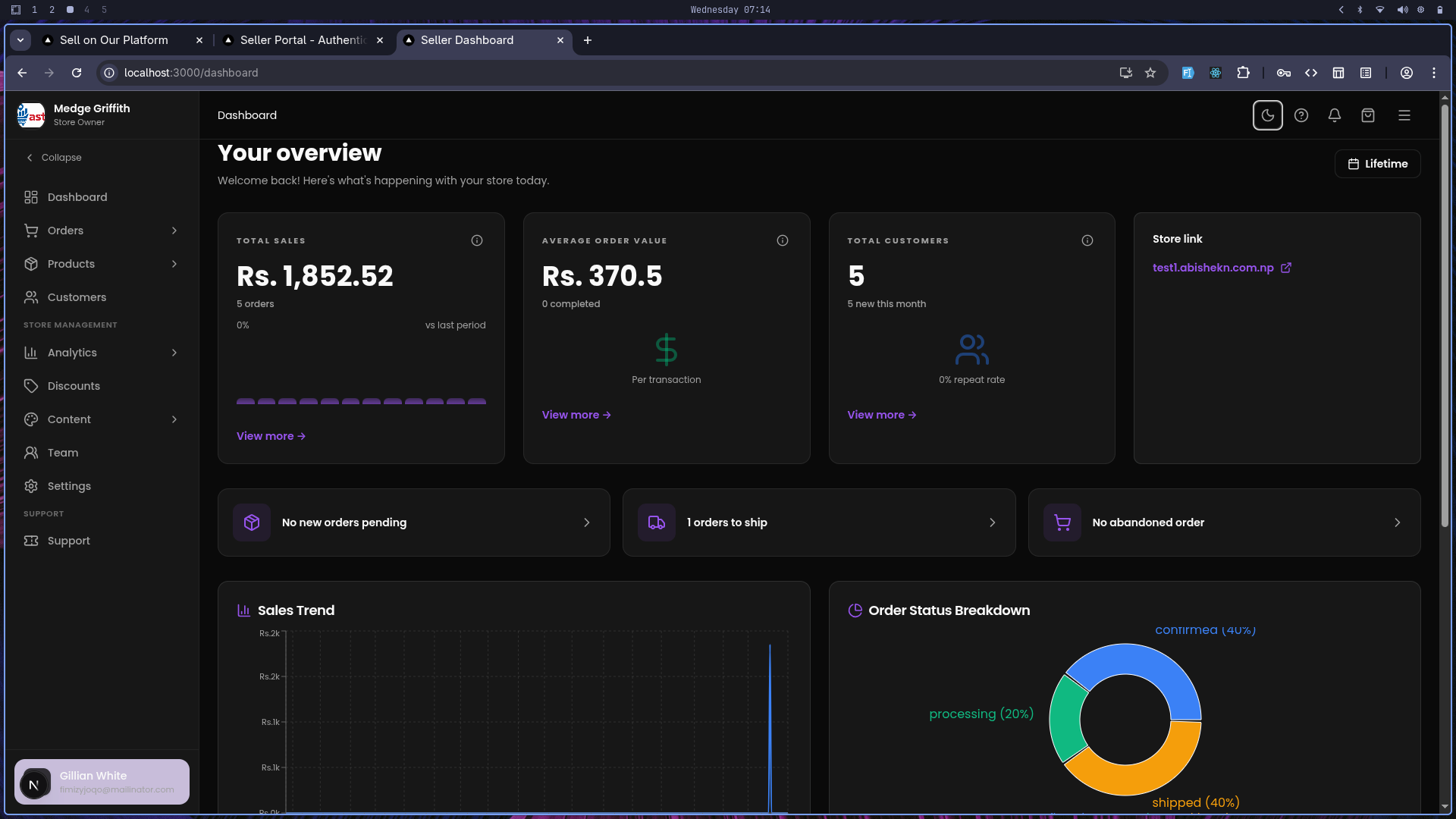
Work completed at Astavision Infosys. I contributed to a commerce platform with independent shops, customer-facing storefronts and administrative workflows.
The engineering problem was to connect the shop a visitor reaches with the appropriate application context, while supporting the different tasks of customers, sellers and administrators.
My contribution
- Worked on tenant/domain resolution and the request context used by the application.
- Built and integrated NestJS REST APIs backed by PostgreSQL.
- Worked with authentication and authorization for customer, seller and administrative workflows.
- Connected React/Next.js interfaces to backend services.
- Contributed to production deployment using Docker on a Linux VPS, with Nginx, domains and SSL configuration.
Application structure
A React/Next.js frontend communicates with the NestJS API. Tenant/domain resolution establishes the shop context; authentication and authorization govern access to application workflows. PostgreSQL stores the application data.
In deployment, Nginx sits in front of the application services. Docker packages the services, while domain, SSL and environment configuration connect the running application to its public addresses.
Engineering considerations
Tenant resolution and authorization need to agree throughout a request. Identifying a shop is only one part of that boundary; each workflow also needs to check what the current user can do.
This work brought API design, database-backed workflows and deployment configuration together. It made the connection between application behaviour and its production environment a practical part of development.